Plain English on the Platform: The Railway Words That Make a Family Day Click
Photo: Matt Buck from London, United Kingdom, CC BY-SA 2.0, via Wikimedia Commons
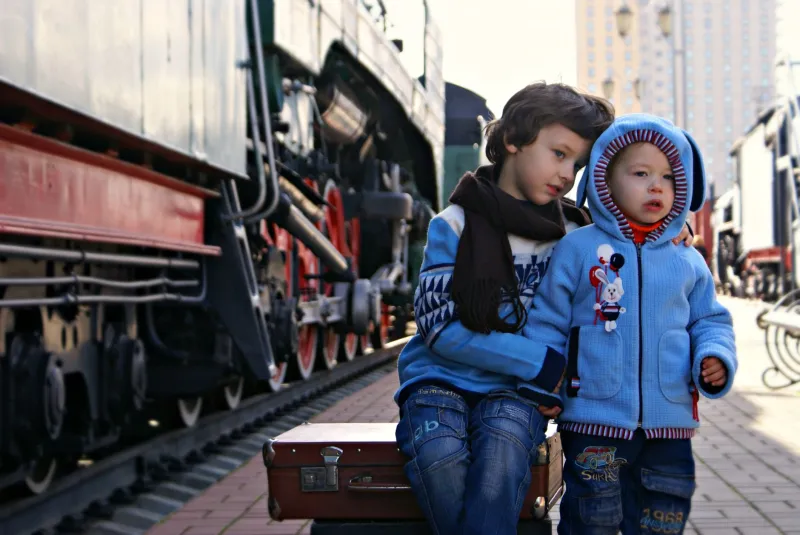
Stand on the platform at Pugneys for ten minutes and you'll hear a whole second language drifting over the fence. Someone will ask whether the coupling's on, someone else will tap a bogie with a boot, and a whistle will cut through the lot of it. None of it is secret. It's just that heritage railways have been using the same words since before your grandparents were born, and nobody ever wrote them down in a way a seven-year-old could follow.
So here's the friendly version. Not a test, not a trainspotting exam — just enough vocabulary to make your first visit feel a bit more familiar, and to give small people something specific to look for when the engine puffs into view.
Why bother learning the words?
Because a name turns a thing into a thing worth pointing at. A child who doesn't know what a buffer is will walk straight past four of them. A child who does will count them, compare them, and ask why the ones at the back look different. Vocabulary isn't a barrier to a good day out — it's the handle on the door.
It helps grown-ups too. If the guard says something about the brake van and you can nod knowingly rather than quietly panic, the whole afternoon runs smoother.
The bits you can point at without leaving the platform
Start at the end of the train, wherever you happen to be standing, and work along it.
Buffers. Those big round pads on the very end of a carriage, sticking out like a pair of shoulders. They're there to take the bump when carriages come together, which is why they look slightly worn and springy. Spot the part: how many round buffer faces can you count along the whole train?
Couplings. The join. Look underneath, between two carriages, and you'll see the metalwork that holds them together — often a hook and a chain, sometimes something a bit more modern. Spot the part: find the spot where two carriages are holding hands.
Bogies. These are the wheeled trolleys underneath each end of a carriage — four wheels apiece on most of ours, trundling along as a set rather than individually. They're what lets a long carriage get round a curve without arguing with itself. Spot the part: from safely behind the yellow line, crouch down and see if you can spot the gap between the body of the carriage and the wheels beneath.
The running gear. A catch-all for everything that moves down there — wheels, springs, rods, all of it. If it's greasy and it turns, it's probably running gear.
Up at the front, where the noise comes from
The boiler. The big cylindrical body of the engine, full of water and steam under pressure. Everything else on a steam locomotive is essentially in service to it.
The chimney. Sometimes called a funnel by the older hands. Watch it as the engine pulls away: a good clean puff means the fire is drawing nicely.
The smokebox door. The round face at the very front, with a handle and a hinge. It opens up so the crew can clear out ash. Ours is polished, because of course it is.
The cab. Where the driver and fireman stand. Look for the small windows and the roof — and, on a cold day, the steam curling out from under it.
The regulator. The lever that lets steam into the cylinders. Opening it is what actually makes the train move, which is why the volunteers talk about it with such affection.
The firebox. The fire. The fireman shovels coal in through a small door, and the whole thing roars quietly to itself. Spot the part: watch for the moment the fireman opens that door — just for a second, you'll see the glow.
The guard and the brake van
The guard is the person in charge of the train behind the engine. They check the doors, they give the signal that says everything's ready, and they ride on the train all day keeping an eye on it. If you need help with anything on board, ask the guard.
The brake van is the little carriage at the very back, usually with an open veranda and a bench. It's where the guard travels, and it exists so that someone can apply the brakes from the rear if they ever need to. In the old days it was also the warmest spot on a freight train, which is why generations of railway families have a soft spot for them. Spot the part: find the veranda. Could you stand there and see the whole train in front of you?
The people in the hi-vis
Driver — drives. Fireman — keeps the fire and the water going, and on a small railway often does half a dozen other jobs too. Station staff — the people waving you towards the right platform and answering the same question forty times a day without sighing. Volunteers — nearly everyone you meet, in truth. Most heritage railways run on people giving up their Saturdays.
If your child asks a question none of this answers, send them to a volunteer. It's the fastest route to a proper answer, and it makes that volunteer's morning.
Whistles, flags and other signals
A guard's whistle is the most theatrical sound on the railway. It's how the guard tells the driver everything is ready and the train can go. You'll hear it, then a pause, then the engine answers — a short, businesslike toot — and off it all goes.
Signal codes differ from railway to railway and have changed over the years, so rather than us guessing at ours, ask a member of the platform team to explain the local version. They'll enjoy being asked.
A five-minute spot-the-part lap
Before you board, walk the length of the train once — past the carriages, up towards the engine — and try these:
- Count the buffers at the back.
- Find where two carriages join.
- Spot a bogie.
- Look up at the chimney and see if there's smoke or steam.
- Find the cab windows.
- Watch the firebox door for a flash of orange.
- Locate the brake van veranda.
- Say hello to whoever's in hi-vis.
That's the whole glossary, done in a stroll. Anything you missed, you'll spot on the way back.
You really don't need to know it all
Nothing here is homework. If you forget what a bogie is by the time you reach the cafe, no one will mind — least of all the volunteers, who have been known to call things by the wrong name themselves when distracted.
The point of the words is simply that they turn a big, noisy, slightly mysterious machine into a collection of familiar parts. Children like that. So, frankly, do most adults.
Come along, stand on the platform, and try a few out loud. It's the easiest way to feel like a regular.