Nappies, Noise and Narrow-Gauge Wonder: A Toddler's Guide to Pugneys Light Railway
Photo: U.S. Navy photo by Chief Photographer's Mate Chris Desmond., Public domain, via Wikimedia Commons
Let's be honest about the appeal. A toddler does not care that the engine was built in 1932. A toddler cares that it is loud, that it moves, and that there is a small door you can peek through. Everything else is a bonus.
So this isn't a heritage piece. It's the practical one — the one I wish someone had handed me before my first visit with a two-year-old who had an opinion about everything and a nap scheduled for the exact moment our train departed.
Pick your moment (the timing matters more than you think)
Mid-morning, just after opening, is the sweet spot. Everything is fresh, the platform is quiet, and the staff have time for a chat. Late morning onwards gets busy at weekends and in school holidays.
Mid-afternoon has one clear advantage: fewer people, and a decent chance your little one falls asleep on the way back. There's something about the rhythm of a small train that works better than any white-noise app.
Avoid the crossover hour around lunchtime if you can. Hungry plus tired plus queue equals a meltdown with an audience.
What to actually pack
Less than you'd take to the park, more than you'd take to a café. The essentials:
- Layers. A platform is a wind tunnel and a carriage is a greenhouse. You'll be doing a lot of zipping and unzipping.
- A spare set of clothes. For the small person. Possibly for you.
- Snacks in a bag you can open one-handed. Silence during a wait is worth its weight in raisins.
- Wipes, obviously. Everywhere.
- A lightweight blanket for the pram, and a muslin for wiping a window so a small nose can see out.
- Sun hat and sun cream in summer — the open carriages are lovely and the shade is limited.
Leave the giant pram at home if you can manage it. A sling or a compact buggy is far easier round the platform and the shed, and you won't be fighting for space.
Noise, and how to pre-empt it
A steam whistle is genuinely loud, especially up close. Tell them it's coming. "There's going to be a big noise in a minute, ready?" turns a shock into an event. Covering ears is fine. Standing back for the first one and edging closer later works well.
We found it useful to warn about the other sounds too: the hiss when the train stops, the clatter of the doors, the sudden bang from the shed. Thirty seconds of preparation beats five minutes of tears.
Waiting, which is the real enemy
The train isn't a theme park ride — it comes back when it comes back. Make the wait part of the trip:
- Count the carriages as they arrive.
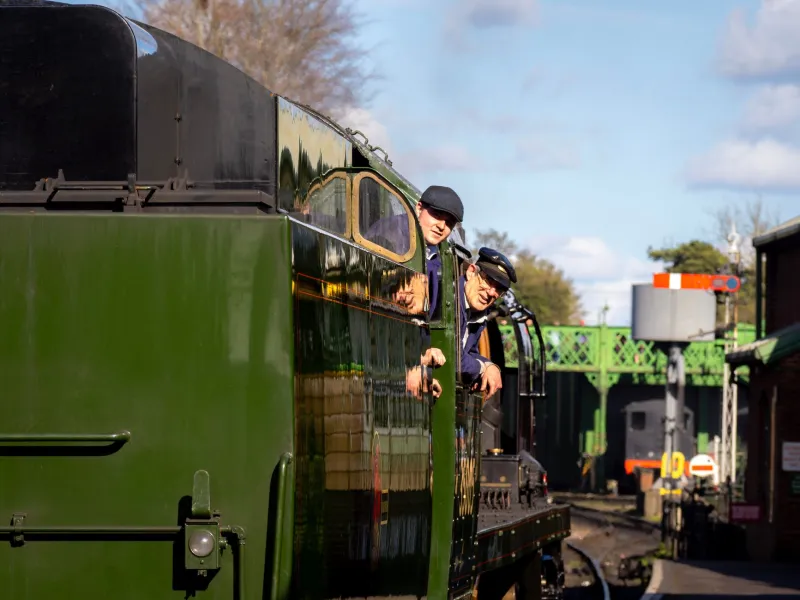
- Spot the colour of the driver's hat.
- Practise the arm-waving technique so it's well-honed for departure.
- Let them watch the watering and the shovelling. Boiler-filling is genuinely fascinating to a three-year-old.
If queues are your kryptonite, ask at the booking point which departures are quietest and plan to do a lap of the lake or a play on the grass between trains instead of standing in line.
Which carriage to choose
The open-sided carriages are brilliant on a dry day and give the best view for a child who wants to see the wheels. On a breezy or damp day, go for the enclosed one — a cold toddler is an unhappy toddler.
Sit towards the back if you want the engine noise slightly further away, or right behind the locomotive if your child is a noise enthusiast (they exist, and they are intense about it). Pushchair users should mention it when booking so the team can point you at the easiest access.
The moments that actually land
It won't be the history. It'll be the ticket inspector clicking a hole punch, the guard's flag, the smell, the bit where the train curves and you can see the engine from the window. One of ours spent fifteen minutes just watching a stream of water run off the tank. Another developed a deep attachment to a wooden bench.
Leave space for that. The timetable is a guide, not a challenge. If they want to stand and stare at the wheels for ten minutes, that's the day out.
Toilets, snacks and the inevitable change
Check the baby-change provision on arrival rather than at the critical moment — it saves a sprint. Bring your own changing mat and bags; bins are around but supplies aren't. Snacks: the café end of things is fine if you go early, but a backup banana has saved more afternoons than I can count.
When it all goes sideways
Have an exit plan and don't feel bad about using it. A child who has had enough has had enough, and a heritage railway is a lovely place to come back to next month. Ride the one train, have a cake, go home. Nobody keeps score.
And if it goes brilliantly — if they wave at the driver, gasp at the whistle, and fall asleep before you've even left the car park — you'll be booking the next one on the drive home. That's how it happened to us.